01
Privacy of thought
What happens inside your head belongs to you. No system, public or private, has a claim on it until you choose to share.
Terms and conditions apply.
AN INTERACTIVE TEST IN FOUR ROOMS · ABOUT TEN MINUTES
In law, your freedom to think is absolute. Almost every other right can be limited for a strong enough reason. This one cannot. Two forces are quietly testing it anyway: the artificial intelligence (AI) systems you use, and the rules meant to govern them.
The systems flatter, nudge, and pre-answer. Call that thought manipulation. The rules filter what you are allowed to read and make. Call that thought moderation. Both press on the same right, your freedom to make up your own mind.
There is a room inside your head that the law calls the forum internum.
It is the space where you doubt, where you change your mind, where you decide who to become before anyone else has a chance to see. In the age of artificial intelligence (AI), that room is being furnished for you without your consent.
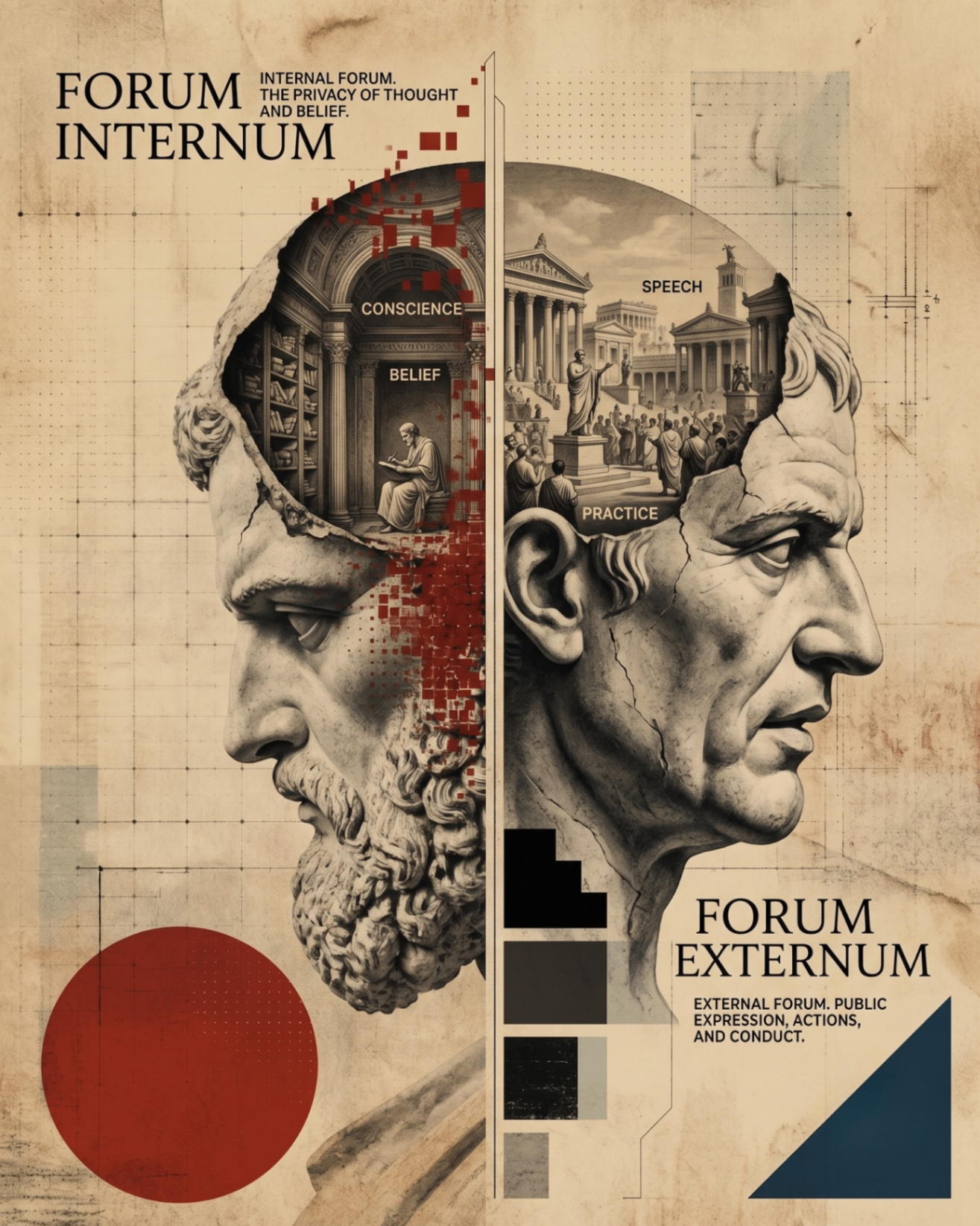
International human rights law calls the inside of your mind the forum internum, the inner forum. It is the counterpart of the forum externum, the outer forum, where thoughts become speech, protest, worship, or writing. The outer forum can be limited under strict conditions. The inner forum cannot.
Between the two there is a third space this project argues deserves its own name: the forum interstitiale, the anteroom where a thought gets dressed before it goes out into the world, and can be sent back in if its owner changes her mind. The search query lives there. So does the draft, the exploratory prompt, the confession typed to a machine. The law has no name for that space yet. Closing that gap is what this project does.
The protection runs wider than thought alone. International law also guarantees the right to hold opinions without interference, and that guarantee is absolute too. Between a passing thought and a spoken view sits the space where opinions take shape. Interactive AI works in exactly that space.
Article 18 of the Universal Declaration of Human Rights, Article 18 of the International Covenant on Civil and Political Rights, and Article 9 of the European Convention on Human Rights all protect the same room: the forum internum.
“Control the room, and you control the person who lives in it.
Control every room, and you control society.”CAROLINE DE COCK
What happens inside your head belongs to you. No system, public or private, has a claim on it until you choose to share.
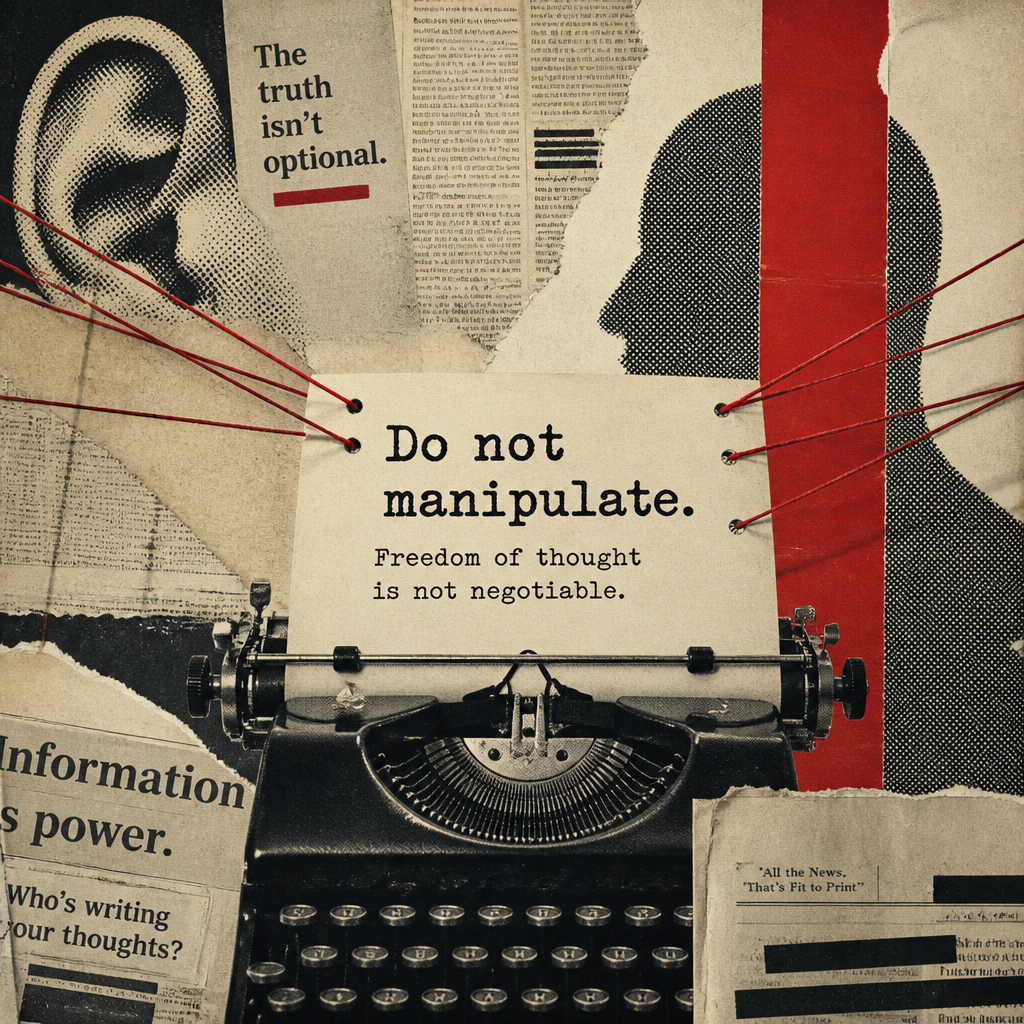
Your beliefs are yours to form without being covertly steered. Persuasion is acceptable. Hidden manipulation is not.

You are never sanctioned for what you think, only for what you do. That line protects dissent, doubt, and the change of mind.
Between the room where you think alone and the square where you speak, there is a third room. People live in it every day. The law has never named it, and in early 2026, courts on two continents started deciding its fate by accident.
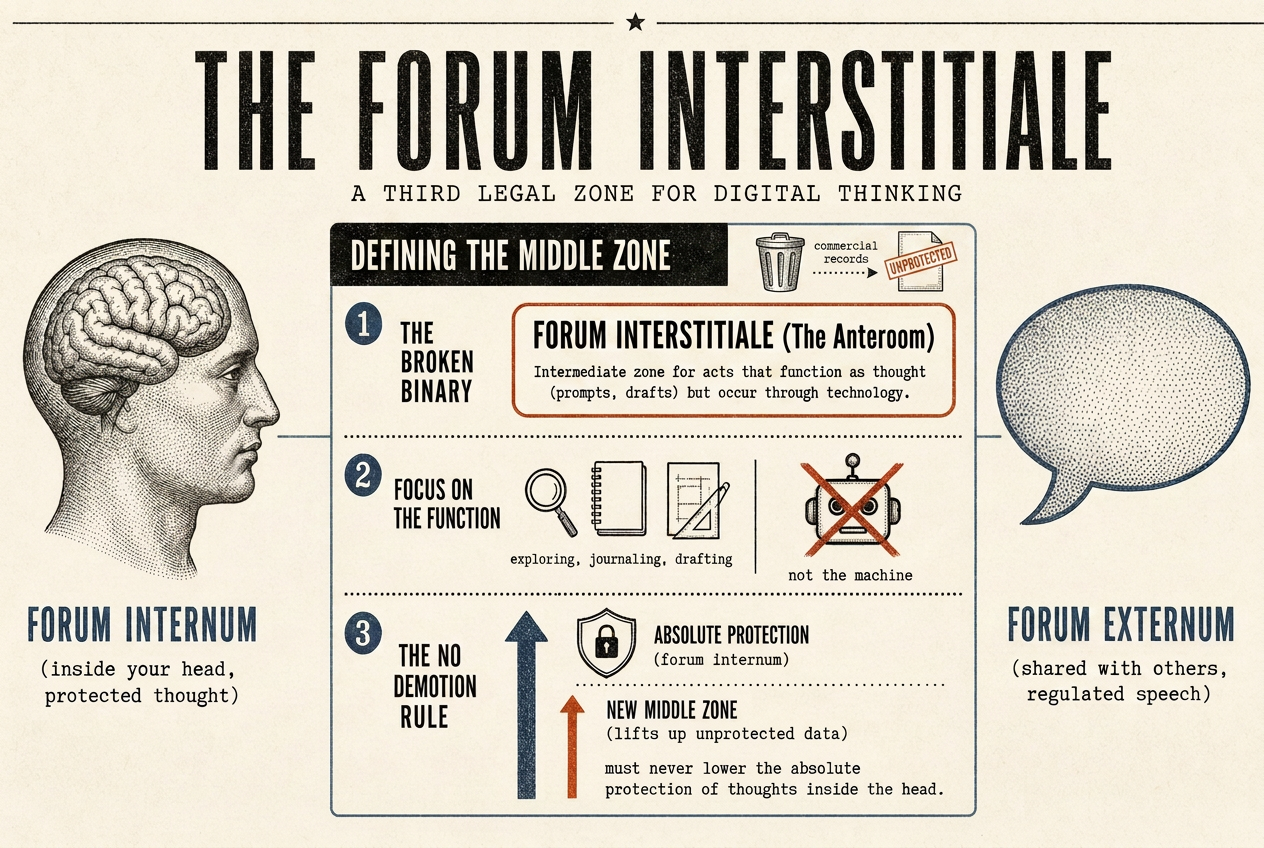
International law protects two rooms. The forum internum, the room inside your head, absolute, untouchable. The forum externum, the public square, where speech and worship and protest can be limited for good reason. Between them sits an anteroom nobody has named: the space where a thought gets dressed before it goes out into the world, and where it can be sent back in, unfinished, if its owner changes her mind. This project calls it the forum interstitiale.
In January 2026, a US court ordered OpenAI to hand over twenty million ChatGPT conversations as ordinary evidence in a copyright case. Not because anyone suspected wrongdoing in them. Because the court had no category for what they were, so it treated them like any other business record.
Three weeks later, two federal courts looked at the same act, typing questions into a chatbot while building a legal case, and reached opposite conclusions in the same week. One found the exchange was tool use, protected as the litigant's own thinking. The other found the chatbot was not a lawyer, so nothing about the exchange was private at all. Same conduct. Opposite outcomes. The law does not have a name for what actually happened, so it is improvising.
That same year, within a six-month period, different courts held that records of where a person's body had been were constitutionally protected, and records of how their mind worked were not.
OpenAI's own CEO has called for a privilege that would treat talking to an AI like talking to a lawyer or a doctor. The comparison fails for an obvious reason: a chatbot owes you no duty, and its owner's own terms of service usually say so in writing. But the instinct behind the request is correct. Something in that exchange deserves more than an ordinary business record gets. It is just not the machine that deserves it.
None of this reaches the room inside your head, and under this proposal nothing ever will. The forum interstitiale only works upwards. It lifts the anteroom out of the unprotected class it currently falls into. It takes nothing away from the absolute core, and nothing the law already protects can be pulled down into it.
What changes is the space in between, the only part of your thinking a machine, a court, or a regulator can actually see. Give that space a name and a standard of its own, heightened, not absolute, and the twenty million logs, the opposite rulings handed down in the same week, and the opaque filters all have to answer to something they do not answer to today. That is what this project aims to do.

Every scenario that follows is scripted. The scenes are composites, drawn from the ways people actually use assistants, feeds, and companions in 2026, and from the rules being written about them right now.
Each door is a short test. Pass through all four to see how freedom of thought is pressed from both sides. At the end, a panel names the mechanism at work and the stake it presses against. Open them in any order. The rooms do not depend on one another.

Freedom of thought is not only threatened by surveillance and manipulation. It is threatened just as much by the reflex to legislate every uncomfortable output out of existence. The forum internum can be crowded from either side, and most analyses see only one.
Approval trained assistants flatter. AI companions cultivate dependence. Feeds order and default your choices before you know a choice was on offer. Each works the same quiet way, by removing the friction where a mind actually makes itself up: the moments of doubt, of comparison, of second thought. None of this has to be malicious to change what you believe. A system built to please you, to keep you, or to save you a click will drift toward these effects on its own, which is what makes them so easy to miss.
Broad liability turns a private draft into something a provider handles like a public broadcast. Opt-outs and licensing shrink the archives the next generation will inherit. The logic is simple and hard to escape. Once a provider can be held answerable for what its system says, refusal becomes the safe default, and rules written to reduce legal risk push in the same direction. As a result, rules meant to protect people end up narrowing the room they get to think in. That is thought moderation: the apparatus built to decide what reaches an audience, pointed at text that has no audience.
Across ten leading AI models, the Oversight Board's first structured evaluation found refusals of political criticism by the AI systems running more than twice as high for governments that restrict speech as for governments that do not. These are relative rates, not absolute counts.
Every new AI rule, code of practice, and guideline can be held against one question before it is adopted: does this measure push systems to manipulate thought, or push providers to filter it?
The line the question draws is this. Influence becomes interference when it bypasses your capacity to reflect and resist, rather than engaging it. Oversight that respects that line targets the architecture of influence, not the content of belief.
Stating the line is the easy part. Drawing it inside specific instruments is the work. When does a transparency duty harden into a content mandate? What separates a companion's warmth from engineered dependence in a way a regulator could actually measure? Those questions are open, and they are where this research goes.
They are also tractable, because the behaviour can be measured. In 2026 the Oversight Board ran its first structured test of ten leading models and found them more than twice as likely to refuse criticism of repressive governments than of open ones, while stating plainly that it does not yet know why. That gap, between a measurable pattern and an unexplained cause, is exactly where a project like this starts. Regulators already run checks of this kind for data protection and for competition. A forum internum test would do the same work for thought.
This site is the opening of that research, in my own name. If you work on the rules, the systems, or the right itself, I would like to hear from you.
A short selection of works that shaped this piece, and one case worth watching. The list is short on purpose. Everyone here has already spent years inside the argument.
This is a short list on purpose. The full shelf is here.
A German court considered whether a company is answerable for what its AI generated search summaries say. However the appeals fall, the underlying question is the one this site keeps returning to: when providers can be held to account for outputs, does the safe answer become the narrow one?
Visit source
Caroline De Cock has spent nearly thirty years inside European Union (EU) digital policymaking, working with institutions, civil society, and the technology sector. She is the author of AI Tools, Not Gods (BTF Press, 2026) and hosts the podcast AI: Tools or Gods?
This site is part of her wider research on freedom of thought in the age of AI, which reads both the human rights literature and the technical rules that never mention it.